Fridge Finder for Tucson Appliance Company
Let shoppers describe the fridge they need.
Live demoBuilt for a prospectPrices as listed Oct 1, 2026
See the exampleOpen the Fridge Finder ↗Open the seven-tab presentation ↗

People led. AI expanded.
Mainstay works alongside you to identify what's holding the business back, decide what needs to change, and carry the work through with your team.
Does the business need more customers, or a better way to handle the work already coming in? Mainstay looks at what is holding it back and carries the changes through with your team.
That may mean making the business easier to find and understand, responding to inquiries, or changing the processes and systems behind delivery. The scope can be a focused project or ongoing operating leadership.
From the recommendation to the work
Explore a working example to see how a business problem becomes something you can use.
These examples show what we can build. Your solution starts with understanding your business and your team.
Business assessment and organizational design
Film · 92 sec
Understand where work gets stuck, agree on the changes that matter and leave with a practical plan and a decision tool tailored to your business.
The film in six chapters
92 seconds, words on screen with music. How a Mainstay business assessment works, from the people who know the business to clear findings, a practical plan and a tailored decision tool.
Words on screen with music, no voice. The words, in order: How a Mainstay business assessment works. You know your business because you’ve lived it. Your team carries knowledge that isn’t all written down. When too much depends on that knowledge staying in someone’s head, work gets stuck and decisions keep coming back to you. Mainstay’s business assessment starts with people. We learn what you want to achieve, listen to the people doing the work, and understand how the business actually runs. Together, we bring that knowledge into view, map the handoffs and check the numbers. Then we decide what can change, what should change, and where automation can help without taking away the judgment that makes your business valuable. You choose what moves forward. You leave with clear findings, a practical plan with priorities and responsibilities, and a tailored decision tool. If you want Mainstay to help implement that plan, we agree that work separately. Your team should understand what changes, who owns it and how the new way of working helps them. People led. AI expanded. Let’s find what would help your business move forward. The picture: a line drawing of an owner and a team. Knowledge that isn’t written down stalls the work, and questions pile up on the owner. Mainstay’s line visits the owner’s goals and each person on the team, and their knowledge gets written down. For five seconds an anonymized welcome package business appears: its package handoffs, then its source workbook, where a review found direct purchase costs missing from the calculation. The findings sort into can change and should change, marked where automation helps and where human judgment stays. The owner chooses what moves forward, and findings, a plan with owners and a decision tool drop into place. Implementation sits apart as a separate agreement. Back in the business, each change gets an owner, the owner’s pile clears and the stalled work flows through. Labels on screen: Actual research. Structure only. Bar lengths illustrative. No client figures. Proposed plan. Timing and scope require agreement. No booking or profit result claimed.
Established businesses, including midsize companies preparing for growth or working through a plateau, where leaders and staff see different parts of the problem.
Work gets delayed, responsibilities overlap, or important knowledge stays with a few people. Sometimes the numbers hide part of it. In the welcome package business this film follows, a workbook review found a missing cost. Adding it back showed that each booking was less profitable than the calculation suggested.
We listen to leaders, interview staff and review how work moves through the business, down to the workbook the numbers come from. The assessment uncovers knowledge held by a few people, documents the workflows, decides what could and should be automated and identifies potential unlocks. Then we follow one offer through cost, capacity and delivery, put the dependencies on a calendar and agree who owns what. The owner approves decisions and records actuals.
The business leaves the scoped assessment with a practical plan and a decision tool built around it (the profitability calculator), useful on its own. If you want the fixes built, the next step is a Mainstay engineer who builds them with your team. The example is anonymized. Its workbook finding comes from actual research, and the bar lengths in the film are illustrative. The film shows a proposed plan. Timing and scope still need agreement, and it claims no booking or profit result.
Mainstay profitability calculator
Film · 102 sec
Your assessment identifies the problem and a proposed solution. Keep a calculator built around your business to see its potential impact and decide what to take forward.
Want Mainstay to carry the implementation through? Let’s talk.
The film in five chapters
102 seconds, words on screen with music. The working decision tool with fictional inputs, step by step: your numbers in one place, change one number, save and compare, then keep using it on your own.
Words on screen with music, no voice. The calculator on screen is the real tool, holding a fictional client’s inputs. Example inputs are fictional. A planning model, not a forecast. The words, in order: Findings. Plan. Decision tool. Mainstay’s business assessment leaves you with a tailored decision tool. The decision tool you keep. Step 1 of 4, your numbers in one place: prices, costs, hours, owner cash target. Owner cash before tax is 2,360 a month against a $2,000 target, covered in the model. See your whole business against the cash you want from it. Each input is marked as evidence: reported or assumed. Every number says whether you know it or guessed it. Step 2 of 4, change one number: price per unit 350 becomes 380, marked as an assumption. Owner cash before tax rises to 2,882, was $2,360. Try a price on your own numbers before you try it on a customer. Units per month 20 becomes 24. Owner hours rise to 72 of 79.5 available, was 60, with owner cash at $2,922. See what more work does to your hours before you say yes. Step 3 of 4, save and compare: save the scenario, then compare. Baseline 2,360 at 60 hours, package price test 2,882 at 60 hours, more bookings test 2,922 at 72 hours. Lay your options side by side, then pick one. Step 4 of 4, keep using it: export the client file. One file holds the inputs, evidence notes and saved scenarios. The work from the meeting leaves with you in one file. After handoff, on your own: import the client file into a fresh calculator, then change groceries per unit from 85 to 95. Owner cash before tax becomes 2,682, was $2,882. Keep testing changes on your own after the meeting. Findings. Plan. Decision tool. Implementation. Want Mainstay to carry the implementation through? Let’s talk.
Businesses finishing an assessment with Mainstay (the business assessment) that want to test a change against their own prices, costs and hours before committing to it.
An assessment names the problem and a proposed solution. Deciding what to take forward still means asking what a change could be worth, and a bigger number at the top can hide costs or hours the business cannot carry.
The assessment leaves a calculator built around the business: its assumptions in view, scenarios saved and compared, and kept for independent use within the agreed support scope. This recording shows the working calculator with a fictional business: raising its core price by $100 clears the owner's target by $22, and doubling the core jobs on top of that lifts revenue to $18,000 but needs 120 delivery hours, against 95.4 available.
The business keeps a decision tool it can use after the meeting to see a change's potential impact and decide what to take forward. Implementation is a separate choice. The inputs here are fictional, and the results show what follows from them. They do not prove demand, actual profit or tax liability.
Forward deployed engineering
Film · 64 sec
Mainstay works with leaders and the people doing the work to agree useful changes, clear ownership and realistic expectations. We help put those changes into practice, test the exceptions and carry the follow-through with your team.
The film in six chapters
64 seconds, words on screen with music. How a Mainstay engineer finds where your work stalls and builds the fix with your team, from one record and one owner to a weekly review.
Words on screen with music, no voice. The words, in order: Your work stalls at the handoff. A Mainstay engineer maps how your work really moves, then builds the fix. Step 1 of 5, find where it stalls. See where work stalls before you buy software to fix it. Step 2 of 5, one record, one owner. When something changes, your team knows who decides. Step 3 of 5, build with your team. Note: sort every step into one of four. Cut. Simple rule. AI agent. Person decides. Built inside the tools you already use. Step 4 of 5, test the exceptions with the team. Open, then resolved. Your team finds the gaps in a test, before a customer does. Step 5 of 5, stay with the improvement. Open items come back every week with a name on them. One record to check. One owner to ask. A weekly review. Mainstay. Carried through with your team. The picture: a technical drawing of how work moves from a website form through an inbox to the job, a calendar and invoices, with a bright spark for the engineer. Arrows stack up at a break after the inbox and question balloons appear. The spark runs the existing route to the break and circles where it stalls, then draws a new connection into one record with a named owner. It stamps each step with one of four marks, and the old broken route turns to dashed removed lines. A test arrow is held at the record, marked open, then resolved, and flows on. The spark draws a weekly review loop, and the revised drawing comes to rest with the Mainstay symbol stamped in its title block. Labels on screen: Illustrative scenario. Proposed AI assistance.
Established businesses with a team and operational complexity, where work passes between people and tools and stalls at the handoffs.
Your work stalls at the handoff. Answers live in too many places, nobody is sure who decides when something changes, and new software bought on top can leave the same stalls in place.
A Mainstay engineer maps how your work really moves, then builds the fix with your team. First we find where it stalls. Then we agree one record to check and one owner to ask. We sort every step into one of four: cut it, a simple rule, an AI agent, or a person decides, and build it inside the tools you already use. Your team tests the exceptions, so the gaps show up in a test before a customer finds them, and a weekly review brings open items back with a name on them.
You get one record to check, one owner to ask and a weekly review, with the work carried through alongside your team. The film is an illustrative scenario drawn as a technical drawing, not a client recording. The AI assistance it shows is proposed, and it claims no result.
Buying-path diagnosis
Film · 116 sec
See where customers struggle to find your business, understand your offer or take the next step. Get an evidence-backed recommendation for what to improve first.
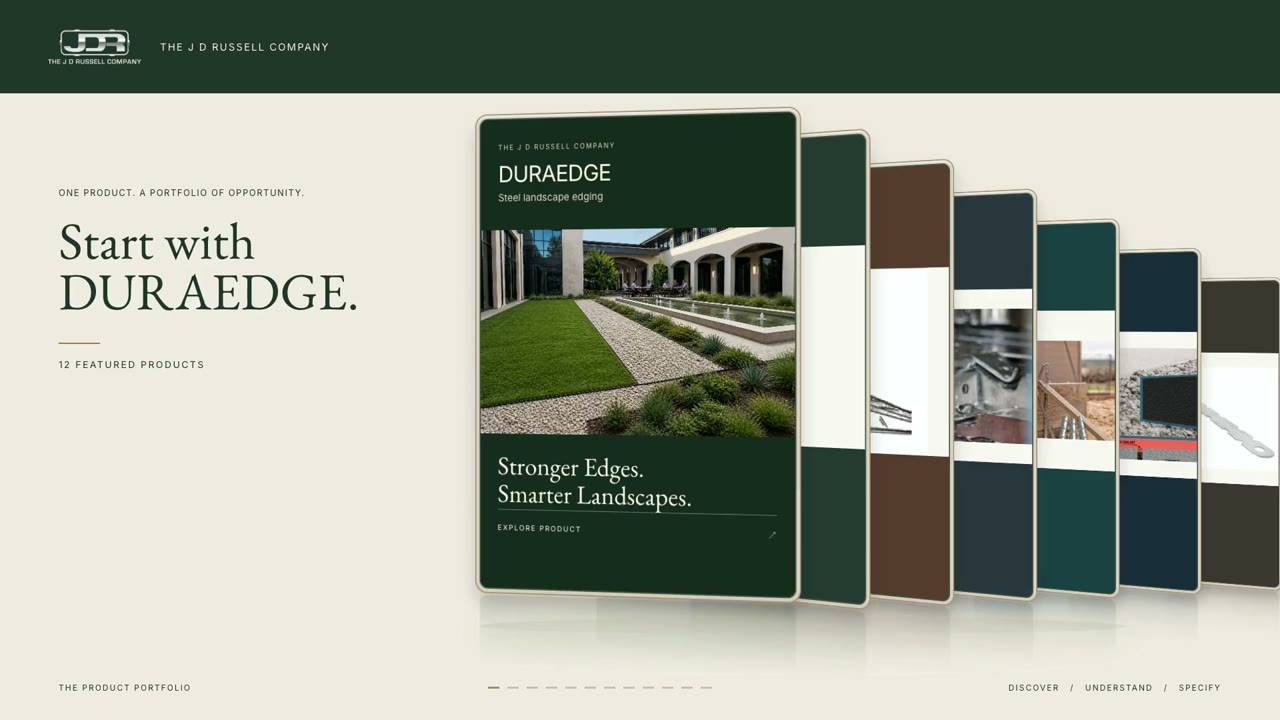
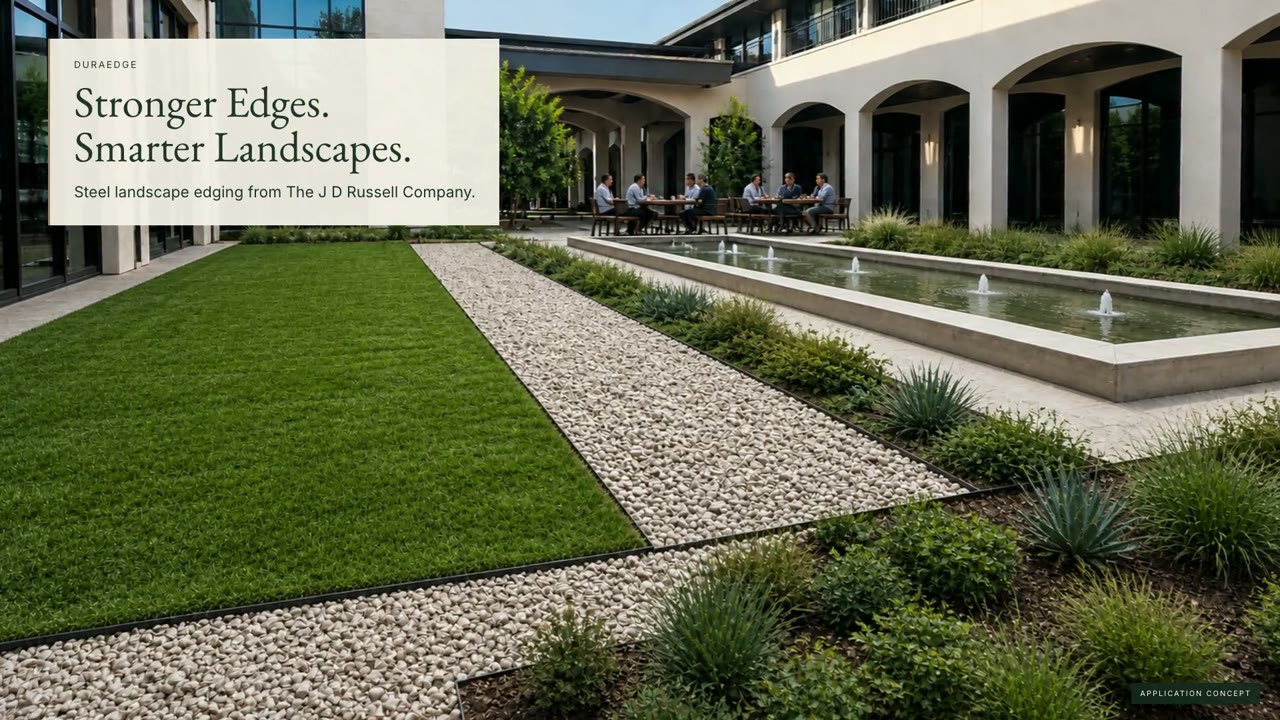

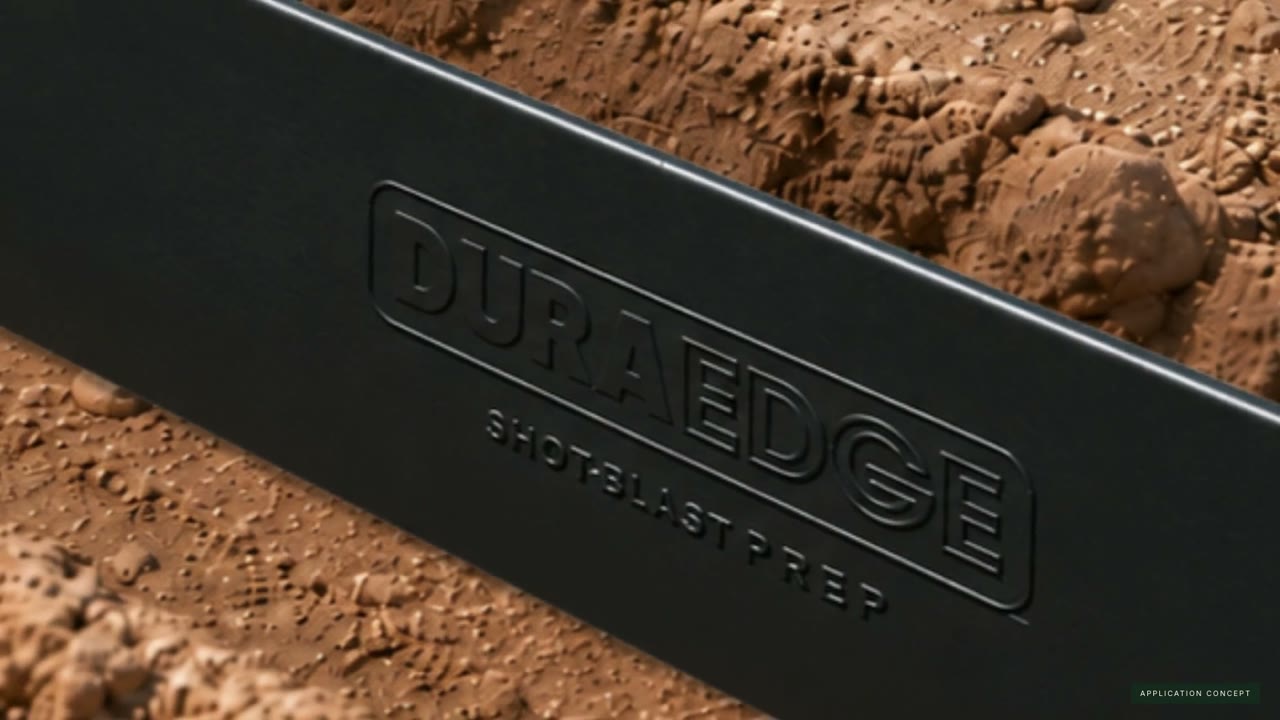
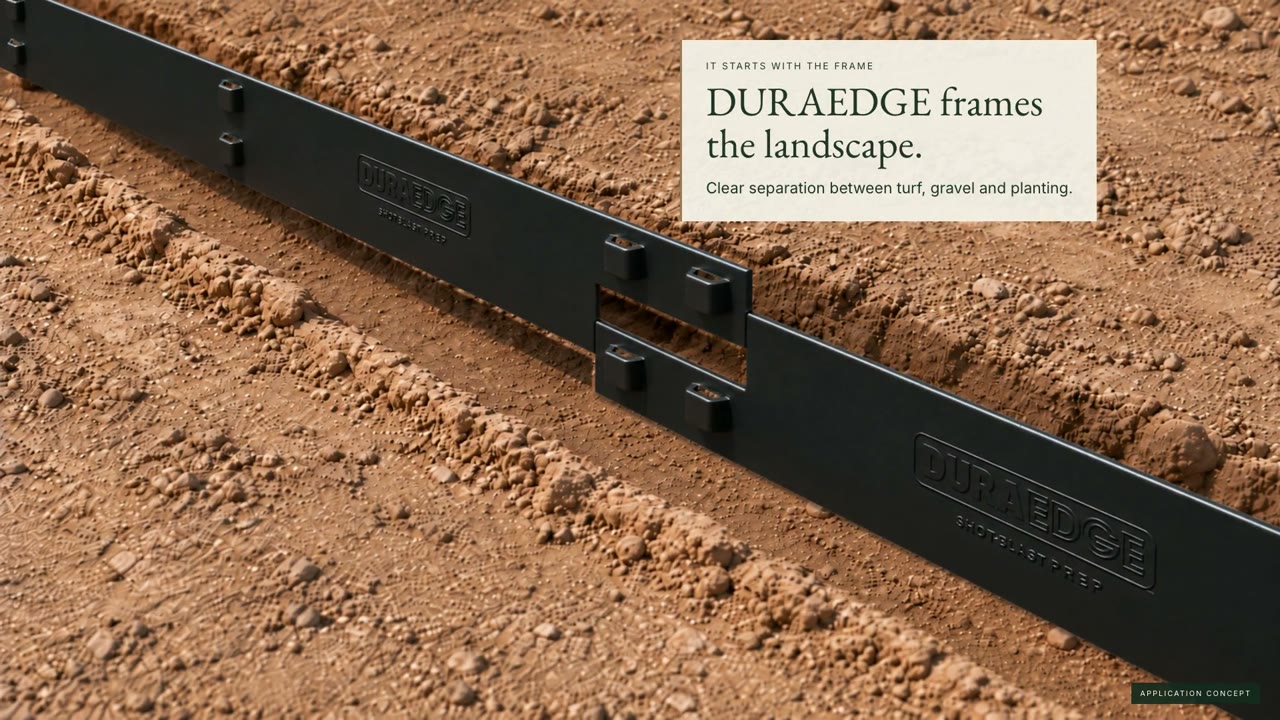
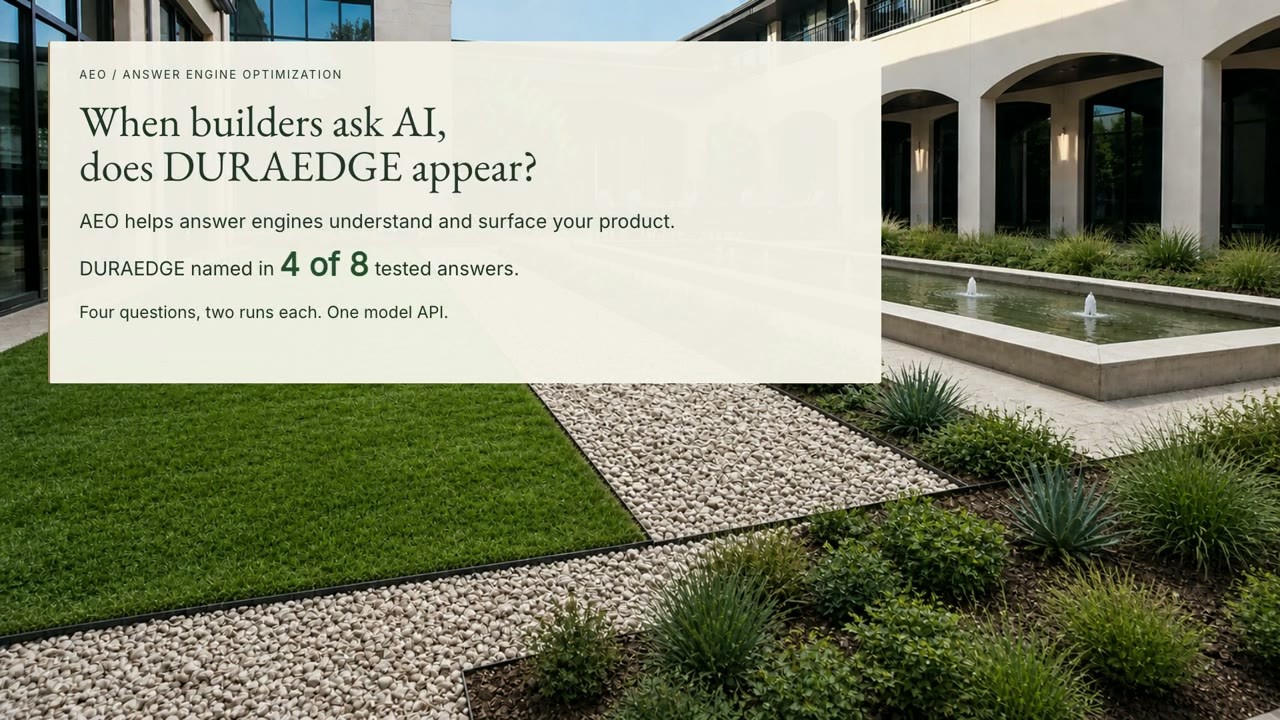
Where DURAEDGE appeared
Snapshot Sep 10, 2026A September 10 snapshot, not a live ranking. The closing brief proposes one test.
Nine slides from the 116-second presentation. Page through them, or play the film from any slide.
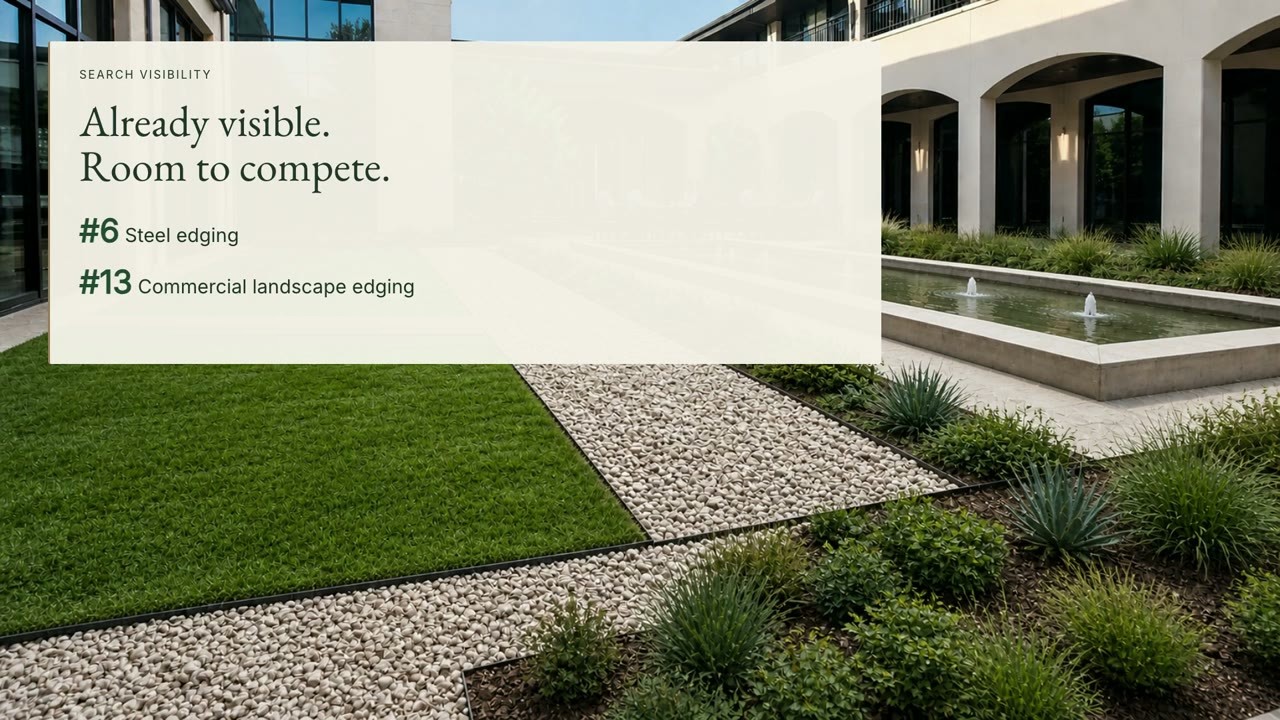
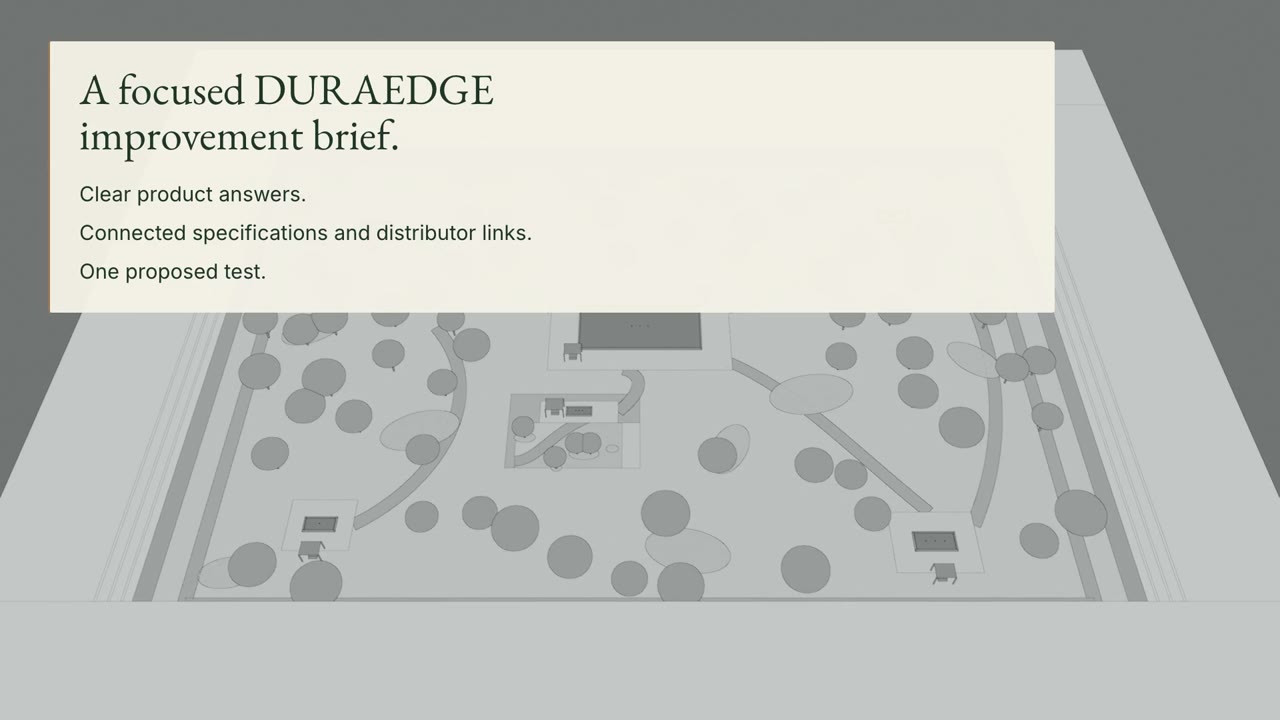
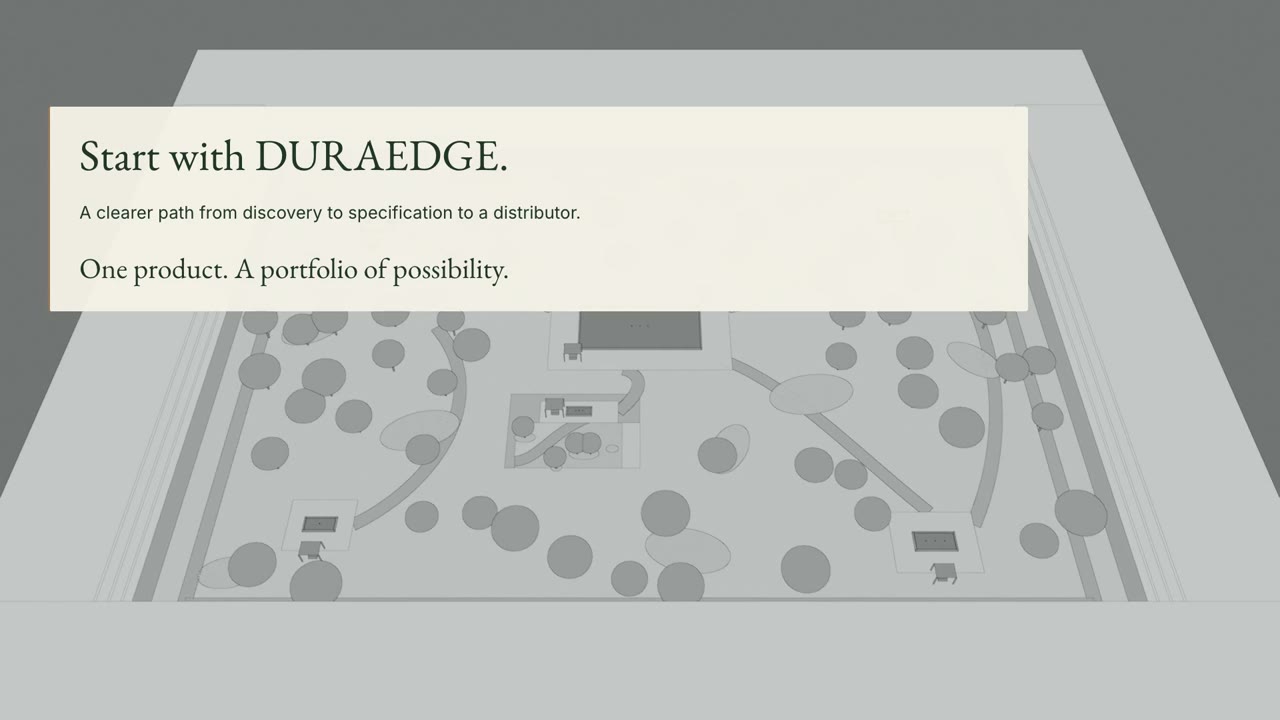
Silent video. Opens on The J D Russell Company product portfolio and the line Start with DURAEDGE, a steel landscape edging product. Shows the edging framing a lawn and gravel bed and close-ups of the shot-blast finish. A search visibility section shows, as captured on September 10, 2026, DURAEDGE ranking sixth for steel edging and thirteenth for commercial landscape edging in search results, named in 4 of 8 tested AI answers, and absent from two sourcing answers that named a distributor. Closes with a focused improvement brief: clear product answers, connected specifications and distributor links, one proposed test.
Manufacturers and distributors whose customers or sales teams need a clearer explanation of a technical product.
Spec sheets and separate photos leave buyers unsure how a product works, where it fits or how it would be used. Finding it is a second problem. In a September 10, 2026 snapshot, DURAEDGE was missing from two sourcing answers that named a distributor.
We bring the product story, supporting information and visual demonstrations into one customer presentation. The DURAEDGE film shows the steel edging framing lawn and gravel, close-ups of its shot-blast finish, and where it stood in search that day: sixth and thirteenth on two edging searches, and named in 4 of 8 tested AI answers. It ends on a brief that proposes clearer product answers, connected specifications and distributor links, and one test.
Buyers and sales teams get one clear explanation to use in a conversation or on their own. The search findings are a dated snapshot. The package is still in progress, and the example shows presentation work, not a measured sales result.
Customer discovery
Interactive
Help people and their AI find what you offer, understand their options and take the next step.
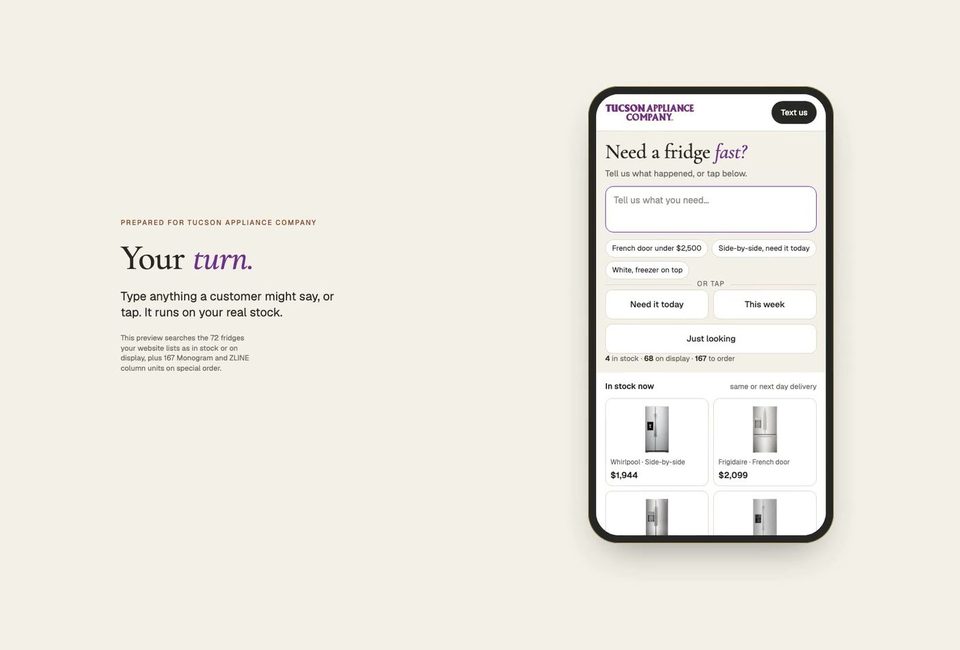
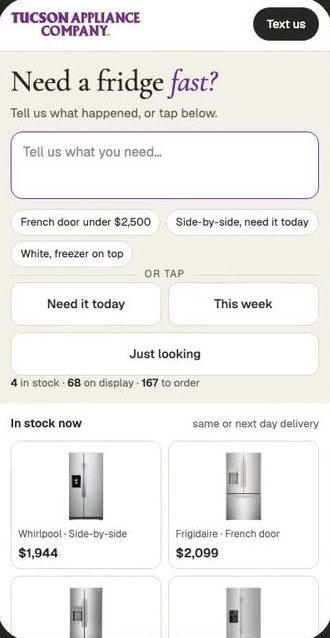
Fridge Finder for Tucson Appliance Company
Interactive
106 seconds, then the live search. Try your own words. Stock and prices as the store's website listed them on October 1, 2026.
Open the Fridge Finder ↗Stores with real stock whose customers want to find, compare and choose what they sell, including customers who ask an AI assistant to do the looking. We built this example for Tucson Appliance Company with our Prospecting Engine.
A shopper replacing a refrigerator knows the space and how soon they need it, but rarely a model number. If stock, prices and availability are hard to read in those terms, for the shopper or for an assistant working for them, the answer becomes a guess.
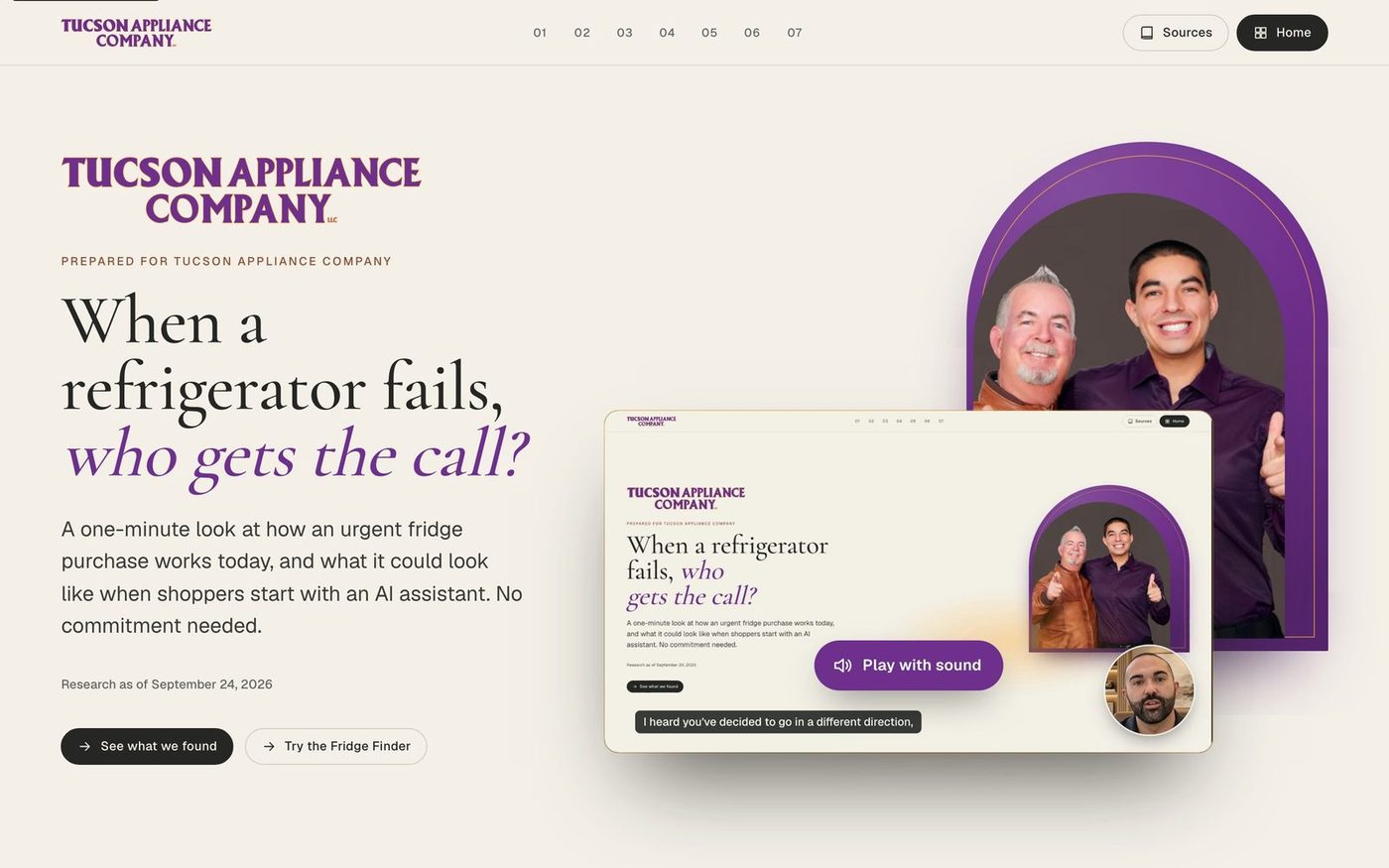
We built a search over the fridges the store's website lists as in stock or on display, priced as listed October 1, 2026. Shoppers type in their own words, and chips show what the search understood. In-stock fridges come first. When nothing in stock fits, it says so and shows what is on display. A 106-second intro film, rendered in code, ends on the search's first screen. We also prepared a seven-tab presentation from research dated September 24, 2026, with two short videos presented by a digital avatar of Tres.
Show the store how its own published stock could answer a shopper and carry the request, in the shopper's words, to a person. In this preview, holds and questions are not sent; connecting them to the store's team is proposed. The example demonstrates the approach, not a measured sales result.
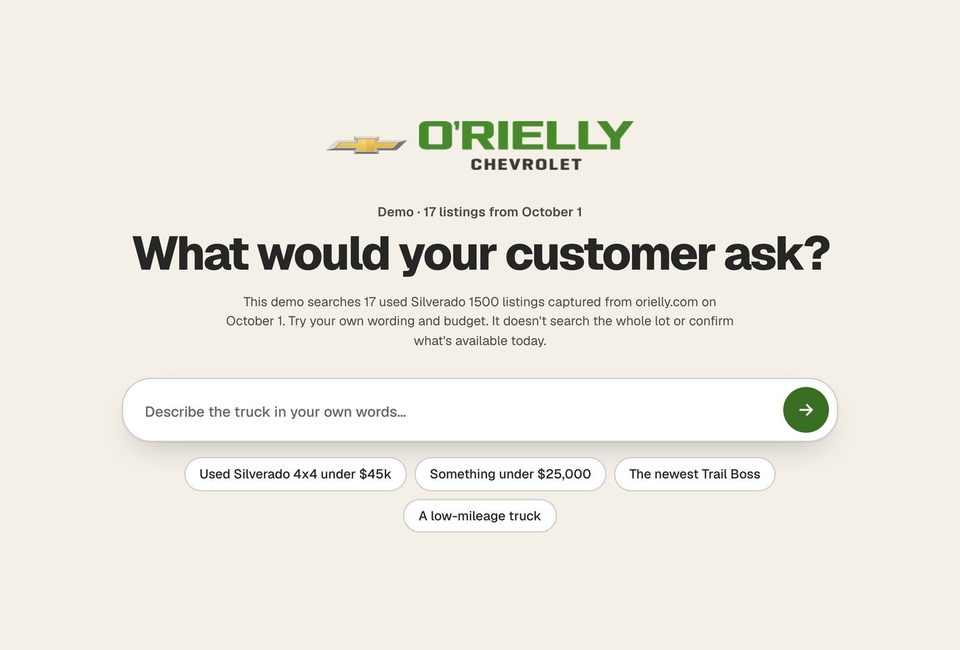
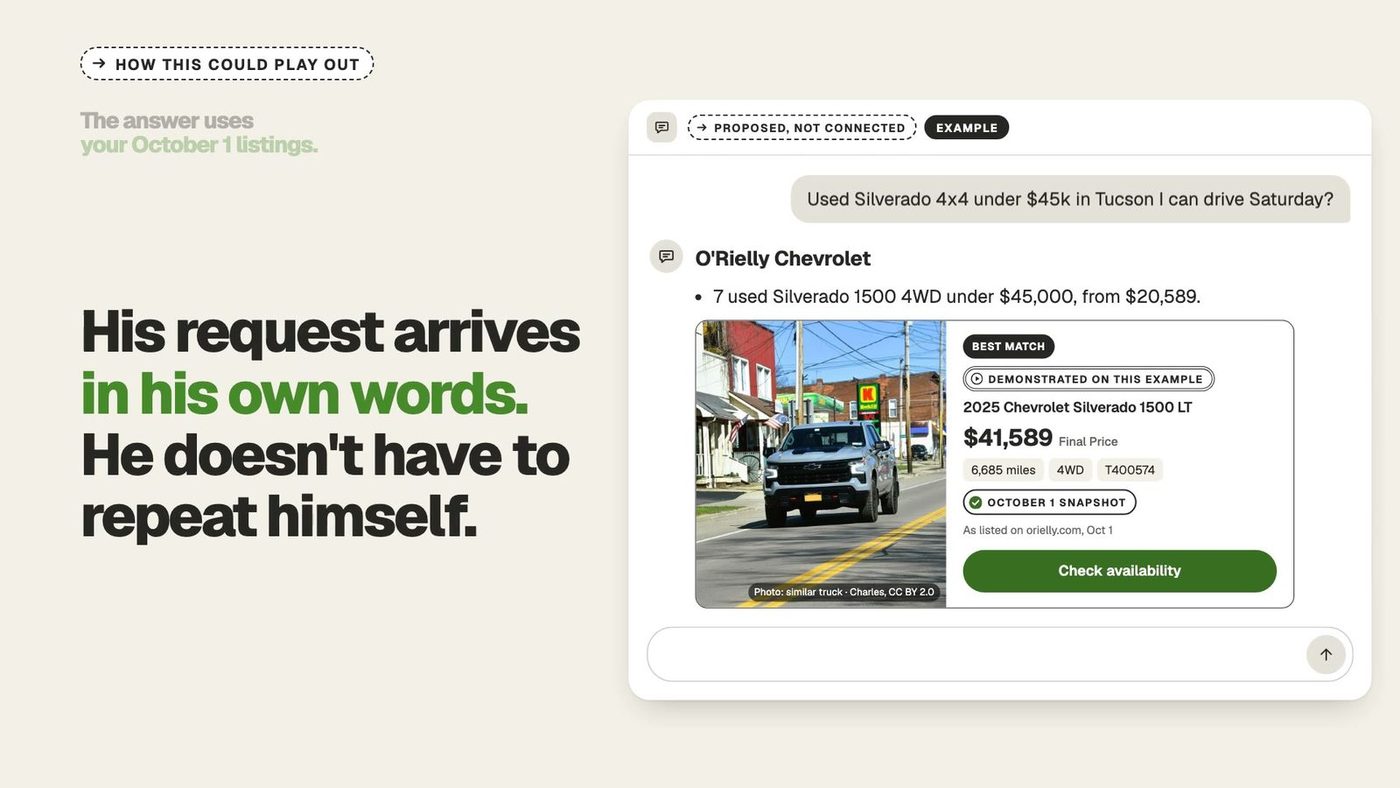
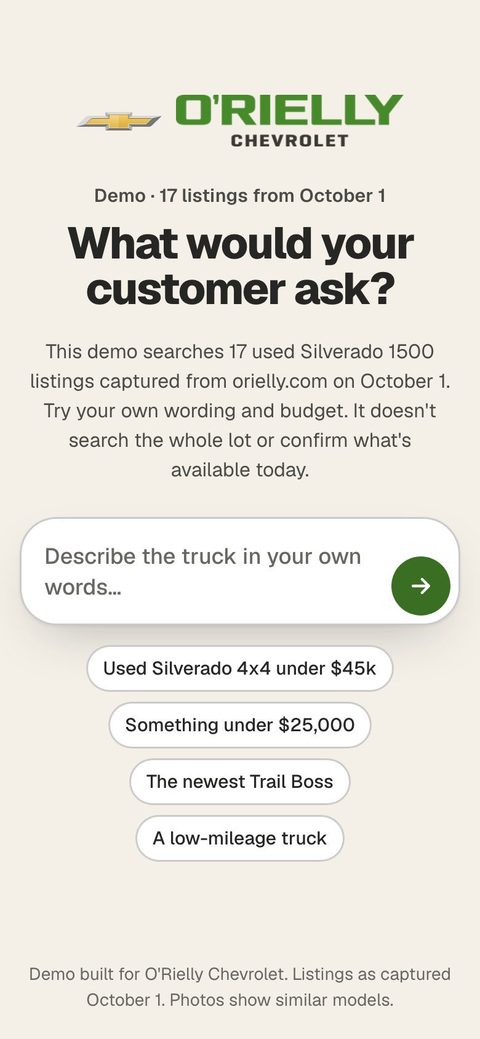
Truck search demo for O'Rielly Chevrolet
Interactive
90 seconds, then the live search. Listings as captured October 1, 2026. Photos show similar models.
Watch the 90-second film ↗Dealerships and other businesses with stock on hand, whose buyers may ask an AI assistant to find and compare what is for sale. We built this example for O'Rielly Chevrolet with our Prospecting Engine.
A buyer may already know the budget and the day they want a test drive. They need answers from real listings, and once a person picks up the request, they shouldn't have to explain it again.
We captured 17 used Silverado 1500 listings from orielly.com on October 1, 2026 and built a search over them. Buyers type their own wording and budget. When nothing fits, it says so instead of guessing and shows the closest trucks in the sample. A 90-second film, rendered in code, shows how a request could reach the sales team in the buyer's own words, then ends on the search's first screen so the viewer can try it.
Show the dealership what a search over its own listings could look like and where a person takes over. The demo does not search the whole lot or confirm what is available today. Nothing is sent from it; passing requests to the sales team is proposed, not connected.
Mainstay Content Machine
Film · 116 sec
Turn market and customer research into content that connects their questions to your offer. Get a monthly plan and content prepared for your agreed channels, ready for your review.
The film in seven chapters
116 seconds, words on screen with music. How a Mainstay content engine turns your customers’ questions into a monthly content plan and pieces for your channels, ready for your review.
Words on screen with music, no voice. The words, in order: Your customers ask. “My AC ran all summer. Is my panel okay?” “Should I fix this leak now or wait for spring?” “Repair my water heater, or replace it?” “Why does my car pull to one side?” “When should I plant to beat the heat?” “Are these ants or termites?” You know how to answer them. If nobody explains, they may not think to call you. Mainstay turns these questions into content for your business. You get a monthly content plan and pieces for your channels, ready for your review. How your content engine works. In: your customers’ questions, your expertise, your offer, your photos. Mainstay’s engine: research, fit, shape, plan. Out: a monthly plan and pieces for your channels, single images today, video proposed. You: your review. Your knowledge goes in. Pieces ready for your review come out. Step 1 of 5, research: your customers’ questions, your market, your season. Each topic traced to its sources. Sourced. Start with what matters to your customers. Step 2 of 5, fit: your offer, your expertise, your look. Unsupported claims cut. Yours. Every claim is one you can back up. Step 3 of 5, shape each piece for your channels. One topic, shaped for each channel: 4:5 feed post, 4:3 listing update, 9:16 vertical post. Each piece fits where it will be seen. Step 4 of 5, plan your month. Your pieces, on your calendar. Your month. See the whole month before anything is posted. Step 5 of 5, bring it to you for review. A change request: Lead with our weekend hours. Your changes, applied. Your call. Change anything before it carries your name. Help customers understand how you can help. Let’s build your content engine. The picture: six question cards, each labelled with a trade (electrician, roofer, plumber, auto repair, landscaper, pest control), gather into one stack that feeds a month plan and frames for a feed post, a listing update, a vertical post and a dashed video slot marked proposed format. A drawing shows what goes in, what the engine does, what comes out and your review. Each step then draws your own version as labelled diagrams: source cards for customer questions, market and season; your offer, expertise, look and photos threading into your topic, with a draft claim struck as not supported; the three frames; a month with three proposed pieces; a review screen that takes a change request and returns the piece revised. Small proof cards tagged “Example: an electrician” show real material from one example: two draft claims struck as not supported, and three single image previews. Labels on screen: Sample questions from different trades. Publishing is a separate approval. Sources show what ran, not what worked. Single images today. Video formats proposed. Dates stay proposed until you agree them.
Service businesses with expertise customers need but may not recognize, and no steady way to explain it. This example is draft creative for an electrical contractor in Arizona.
A homeowner knows the air conditioner worked hard all summer. What that demand means for the electrical panel may be less obvious. If the business never connects the two, the customer may not think to call.
We start from a question customers have and the expertise behind the answer. For this contractor, the September headline reads: “Your panel worked as hard as your air conditioner did.” We adapt the idea for each agreed channel, review each version as a whole before it represents the business, and place every approved piece on a month plan. Single image creative is the production work in place today; video formats are proposed.
The owner gets a repeatable way to explain the business, without inventing every post from scratch. This is September 2026 draft creative, and its dates are not set yet. No post was published, and no engagement result or client approval is shown.
Sales preparation workflow
Film · 112 sec
Help your team spend less time researching prospects and drafting outreach. We build a workflow around the customers you want to reach, deliver a reviewed sample batch, and train your team to keep it running.
The film in seven chapters
112 seconds, words on screen with music. How Mainstay sets up a sales preparation workflow for your team, in five steps: criteria, research, tailored draft, review and training.
Words on screen with music, no voice. The words, in order: Help your team spend less time researching prospects and drafting outreach. Mainstay helps your team turn prospect research into prepared sales conversations. We build a workflow around the customers you want to reach, deliver a reviewed sample batch, and train your team to keep it running. The five steps: Criteria. Research. Tailored draft. Review. Training. Step 1 of 5, criteria: who you want to reach. Lead chosen by hand, matches your criteria. Only leads that fit. Research time goes to the prospects you want to reach. Step 2 of 5, research: captured public page. Observed, then a question for the owner. Seen, then asked. Every question traces back to a source your team can check. Step 3 of 5, first approach: question. Linked research: marketing tags, contact page. Tailored to each lead. Your team starts from a draft, not a blank page. Step 4 of 5, reviewer: sales lead. Accepted for handoff, nothing is sent. Batch size: agreed with you. A reviewed sample batch. Your team reviews every draft. Step 5 of 5, hand over: criteria, checklist, template. Practice record, handoff owner: sales lead. A process your team can repeat. Your team prepares the next batch itself. Research. Drafts. Review. Training. Give your sales team more time to sell. Let’s build your team’s outreach workflow. The picture: a pile of prospect cards beside an empty email draft, gathered into a folder. Then the workflow’s own screens, one step at a time: a prospect criteria sheet with a team review stamp and five lead cards with their names withheld, one chosen as Lead A; a rebuilt public page turned to its source, where an analytics tag and an advertising tag light up, and research cards that keep what was observed, the question for the owner and what is still unknown apart; a choice of first approach, then an email draft and a short message draft built around that question, linked back to the research; a review row where the sales lead accepts both drafts for handoff, and a sample batch table; the prospect criteria, research checklist and outreach template handed over with a training guide and a practice record. Labels on screen: Example lead. Name withheld. Proposed workflow. Illustrative drafts. Nothing is sent. Ongoing support is optional and agreed separately. Proposed workflow. No pipeline result is promised.
Businesses with a sales team that spends too much time researching prospects and drafting outreach. The example is Mainstay's own internal process, which we used to build the customer discovery examples.
A business name and a website don't show whether there is a problem worth solving. A generic message leaves the owner to guess at the value. A team needs evidence and a useful question before it reaches out.
The engine runs seven steps, from defining fit to earning the next conversation. For an example roofing company in the Phoenix area, the captured pages showed analytics and advertising tags, published office hours and an office phone. That became two questions for the owner: can you tie an inquiry to the marketing behind it, and what happens when a roof problem arrives after hours? Then we built a homepage concept and drafted outreach around it.
For a client, we set up the workflow around the customers they want to reach, deliver a reviewed sample batch and train the team to keep it running. Ongoing support is optional and agreed separately. The research raises questions; it does not prove lost calls. The outreach examples are illustrative drafts, nothing is sent automatically, and no pipeline result is promised.
Second brain, a personal AI partner
Film · 72 sec
A personal AI partner designed around an evolving neurocognitive profile of how you work. It retains your decisions and carries authorized work through execution, checks and follow-through, so you can shape the brief and review the result with less repeated explaining, supervising and chasing.
Follow one memory through your second brain: tell it once, it is kept for good, brought back when you return to the work and kept current when something changes.
The film in six chapters
72 seconds, words on screen with music. How your second brain works: tell it once, it keeps what matters, brings it back and keeps it current, then does the work and waits for your yes.
Words on screen with music, no voice. The words, in order: I wish there was more time in the day. I wish I could clone myself. Mainstay designs and sets up your second brain. A second brain, put to work. A personal AI partner designed around how you work. Tell it once. Held in working memory, ready right away. What keeps coming up is kept, without you filing a thing. Kept for good. Brought back. Pick up right where you left off. Kept current. When something changes, it updates what it knows. It does the work, checks it, and waits for your yes. 10, you direct. 80, your second brain does the work. 10, you review. More time for the decisions that need your judgment. Mainstay. The picture: loose dots gather into a brain drawn as a map, with four stops: tell, keep, recall, update. The camera dives into one dot and follows a single memory. A new sample note, client prefers calls after lunch, arrives and is held right away. Repeated, it settles for good, while a one off dot fades. A sample question, picking up the client proposal, brings it back. A sample office address is struck and rewritten when it changes. The work then runs in lanes, one held at its gate for your yes, and the camera pulls back over the whole brain. Labels on screen: Map of your second brain. Not to scale. Product in development. Illustrative product experience. Sample. Intended division of effort. Not a measurement.
Owners, leaders and independent professionals who move between projects, change direction and return to unfinished work, with decisions and commitments spread across messages, calendars, documents and tools.
There is never enough time in the day, and you cannot clone yourself. Preferences, decisions and changes are spread across messages and documents, so the same context gets explained again and picking work back up means rebuilding where you left off.
Mainstay designs and sets up your second brain: a personal AI partner designed around how you work. Tell it something once and it is ready right away. What keeps coming up is kept without you filing a thing, it brings back where you left off, and when something changes it updates what it knows. Then it does the work, checks it and waits for your yes.
You direct, your second brain does the work, and you review, so more of your time goes to the decisions that need your judgment. That split is the intended division of effort, not a measurement. The second brain is a product in development: the film shows an illustrative product experience with sample material, not a demonstrated end to end result.
Team AI partners
Film · 56 sec
Explore a team of personal AI partners designed to support how each person works and carry authorized tasks forward together. Shared decisions, clear ownership and connected handoffs keep everyone working toward the same result, with people reviewing the decisions that need them.
The film in five chapters
56 seconds, words on screen with music. How team AI partners keep a handoff connected: one change every view agrees on, a review of the real work, and the next person ready.
Words on screen with music, no voice. The words, in order: When work passes between people on your team, you end up chasing every handoff. Which draft am I reviewing? Any update? Mainstay designs and sets up a personal AI partner for each person on your team, and one shared view of the work you all depend on. Marketing, Service lead, Operations manager, Front desk lead, each marked private to you. Step 1 of 3, every view agrees. Send to service lead. Plan page, draft 2. Change it once, and every view agrees. Step 2 of 3, review the real work. Visit schedule: two visits a year, changed, was once a year. Decision: two visits a year, accepted by Operations. You review the work itself, not a status. Accept draft 2. Accepted: the exact draft, on record. Step 3 of 3, keep the handoff connected. Accept the work, and the next person is ready. Move work forward without chasing every handoff. The picture: a glass miniature of an office with a room for each role. A question thread leaves the marketing room and dies at the doorway. Pulling out, each person’s partner lights up and a shared view rises with four tasks, each with its owner, status, next action and what it depends on. Marketing sends draft 2 to the service lead, and the change shows in every view. The service lead reviews the page itself and accepts it, and the two tasks that were waiting on it turn ready. Labels on screen: Illustrative project. Fictional people. Product in development.
Businesses where people, projects and decisions depend on one another, and status lives in separate lists and threads.
When work passes between people, someone ends up chasing every handoff, asking which draft is under review or whether there is any update. When updates are scattered, it is hard to see what is blocked, who is responsible and what should happen next.
Mainstay designs and sets up a personal AI partner for each person on your team, private to them, and one shared view of the work you all depend on. The film follows an illustrative project with fictional people in four roles. Marketing sends draft 2 of a plan page to the service lead, and every view agrees on the change. The service lead reviews the page itself, with what changed and the decision on record, and accepts it. The two tasks waiting on that page, for the operations manager and the front desk lead, are ready.
Ownership and handoffs sit beside the work itself, so the next person can start without anyone chasing. Each partner is private to its person, and you review the work itself, not a status. Team AI partners are a product in development: the film is an illustrative project with fictional people, not a customer rollout or a measured team result.
Home visualization
Interactive
Turn plans into a shared view of the home, then explore real materials in the space. Compare choices, save the details and give the designer or builder a clear selection to review before the work moves forward.
Material, lighting and styling directions to review beside the current model. These generated references show choices that are not yet fully modeled.
Open the full Altadena lookbook (PDF)30 seconds. One steady turn of the great room, rendered from its 360 panorama. The panorama is a draft under review.
Jump to a room
See the lookbook's generated references and a draft 360 turn of the great room, then walk four rooms.
Homeowners and builders comparing design choices, and manufacturers or distributors showing how their products fit into a space.
Plans and separate samples are hard to picture together. Layout, materials and product choices get decided on paper, and the full picture may only appear once the work is underway.
We build a 3D model from the plans and prepare views around the decisions being made. For the Altadena build, the walkthrough moves through four rooms, from the family room to the primary bedroom. A 360 turn of the great room, from a draft panorama, and a lookbook of generated material and lighting references sit beside it.
Owners, builders and product teams can discuss scale, layout and materials from one shared view before committing. Altadena is a personal reference project. Choosing real materials in the space, trying pattern and orientation, saving and reopening a selection and handing it to the designer or builder are the intended experience, still in development and not shown working here. The lookbook's generated directions are not yet fully modeled.
A contractor has room for more work, but too few inquiries. We assess how customers find and evaluate the business, then choose the work needed: a clearer website, search and AI-answer visibility, or social content, photos and video that help explain the offer.
A good product takes too much explaining. A product presentation or visual walkthrough can help buyers understand how it works and where it fits.
See the customer-facing examples belowA busy service business misses calls while its team is working. We assess how inquiries are handled and whether a virtual receptionist, chat or better routing would help.
An established company enters the same information into several systems. We can connect customer and scheduling tools or build a tool around the workflow.
Work stops when an experienced employee is away. We capture that knowledge in documented processes the team can find and use, with clear responsibilities.
See how we assess and change the work, belowThese are examples of situations Mainstay can assess, not promised results. The right response depends on the business. More marketing or automation is not always the answer.
The judgment behind the work
“If we do this, what actually gets better for the business?”
More leads can expose an already strained operation. New software can add another place to enter the same information. AI can speed up work that should have been redesigned first.
We start with what you want to change, look at how the business actually works, and decide where the effort is worth it.
The “so what?” test
If we don't see a worthwhile reason to work together, we'll tell you.
How operating work happens
We listen to business leaders and interview staff. We look for gaps at handoffs, repeated work and essential knowledge that exists only in someone's head. The assessment identifies what needs to change.
We turn that knowledge into usable processes with clear responsibilities. We distinguish tasks that need someone's expertise and judgment from tasks that can be delegated or, where appropriate, automated.
We work with the team to implement the processes and connect or build the tools it needs. The scope depends on the business and the problem.
We review how the changes work in practice and address obstacles. The aim is to handle workload and growth while people focus on work that makes the best use of their skills.
AI and the work
An AI assistant is good for exploring ideas and drafting material. Our work starts with the people doing the job: we find where things stall, then help your team decide which changes are worth making and put them into use.
That may mean documenting knowledge, changing a handoff, assigning responsibility or connecting tools. AI can support the work where it fits. The engagement is scoped around the change your business needs and how to put it into use.
Who this is for
Mainstay works with established businesses, including midsize companies preparing for growth, working through a plateau or changing how they operate. You may need more demand, more capacity or a clearer way to present what you do.
You may need help carrying a larger change through the business. Or you may have a specific project in mind. Tell us what's happening now and what you want to change so we can discuss a useful scope.
Know a business facing one of these problems? Share the portfolio and connect them with Mainstay Automation.
Email MainstayOpen the one-page overview
Or write to [email protected].
Business assessment and organizational design. Offer and pricing analysis. Customer acquisition and content systems. Knowledge capture and AI assistance. Operating dashboards. Custom tools and software integration.
The profitability calculator and operational improvement. Product visualizations, prospect demonstrations for Tucson Appliance Company and O'Rielly Chevrolet, and Mainstay's internal Content Machine and Prospecting Engine. Mainstay's internal second brain and Company OS. Architectural visualizations. These projects are in progress; illustrative examples and proposed capabilities are identified.
Established businesses with customers, revenue, and operating complexity. We assess the need, agree on scope, implement, and review results.